Free Retirement Planner Excel Template
Will you actually be able to retire? Stop guessing. Enter your age, savings, and monthly contribution, and get a year-by-year projection of your nest egg — plus how much of it is growth doing the heavy lifting.
What's inside
- Inputs: current age, retirement age, current savings, monthly contribution, expected return
- One-click projected nest egg via future-value math, with totals for contributions vs growth
- Full year-by-year table: age, starting balance, contributions, growth, ending balance
- Table auto-blanks years past your retirement age
- Frozen header row for scrolling through decades of compounding
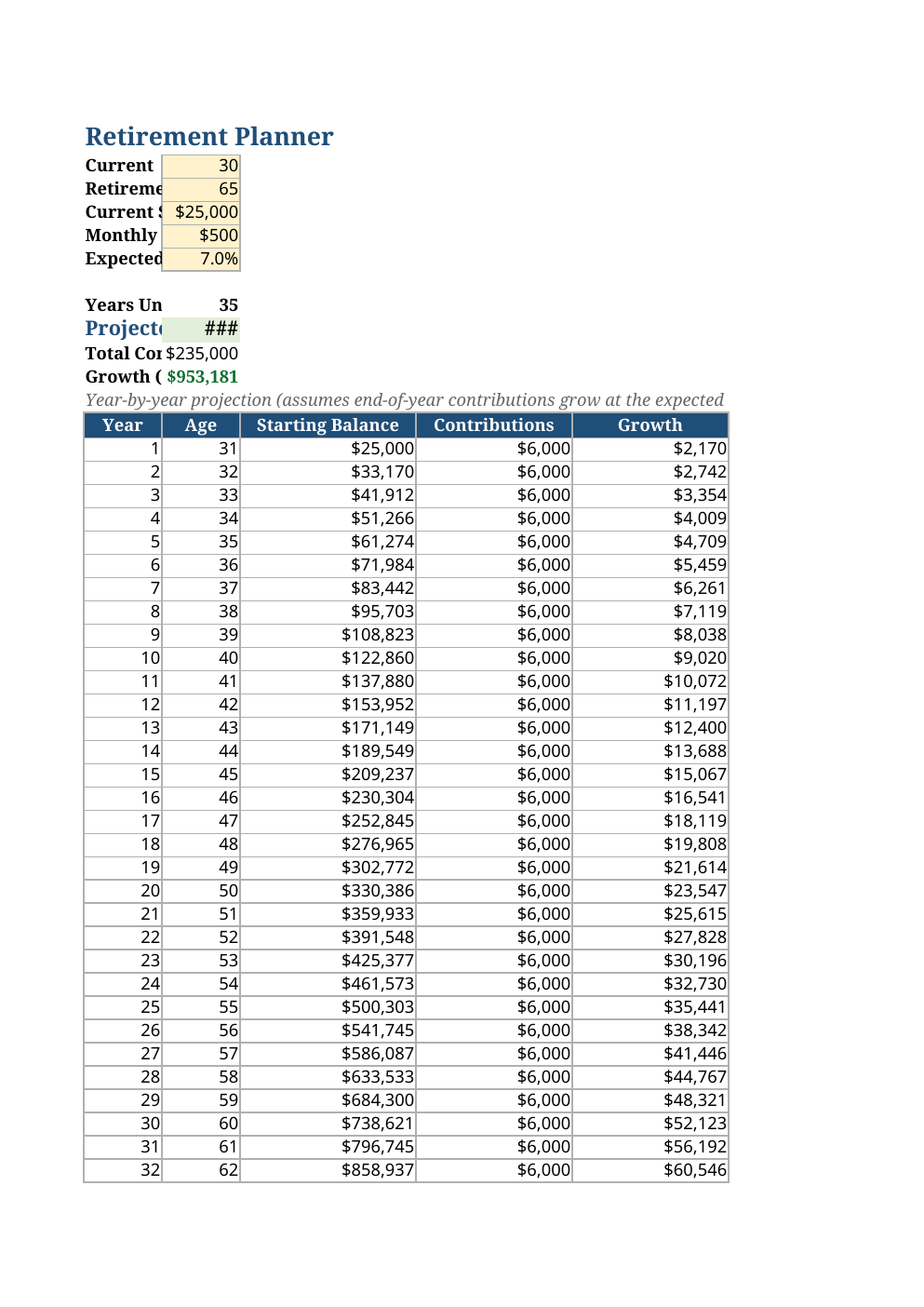
Opens in Microsoft Excel, Google Sheets, and LibreOffice. No signup, no watermarks.
How to use this template
Fill in the five yellow inputs honestly — especially the expected return. 7% is the long-run US stock market average after inflation is closer to 7% nominal... most planners use 6–7% nominal; be conservative rather than hopeful.
The headline number is your projected nest egg, but scroll to the breakdown: Total Contributions versus Growth. For most people starting early, growth eventually dwarfs contributions — that gap is the visual argument for starting now instead of next year.
Model the big levers: add $200 to the monthly contribution and watch the ending balance jump; retire two years later and see compounding's final sprint. Small changes early beat big changes late — the table proves it row by row.
Frequently asked questions
What return rate should I assume?
Many planners use 6–7% nominal for a stock-heavy portfolio, or ~4–5% after inflation for 'real' purchasing power. When in doubt, run it at 6% — conservative beats disappointed.
Does it account for inflation?
No — projections are in nominal dollars. Roughly halve the growth assumption for an inflation-adjusted feel, or just remember future dollars buy less.
What about employer 401(k) matching?
Include the match in your monthly contribution — it is real money going in. Just remember vesting schedules if you might change jobs.
Is this financial advice?
No — it is arithmetic. For personalized advice, talk to a fiduciary financial advisor. This sheet just makes the math visible so those conversations start smarter.